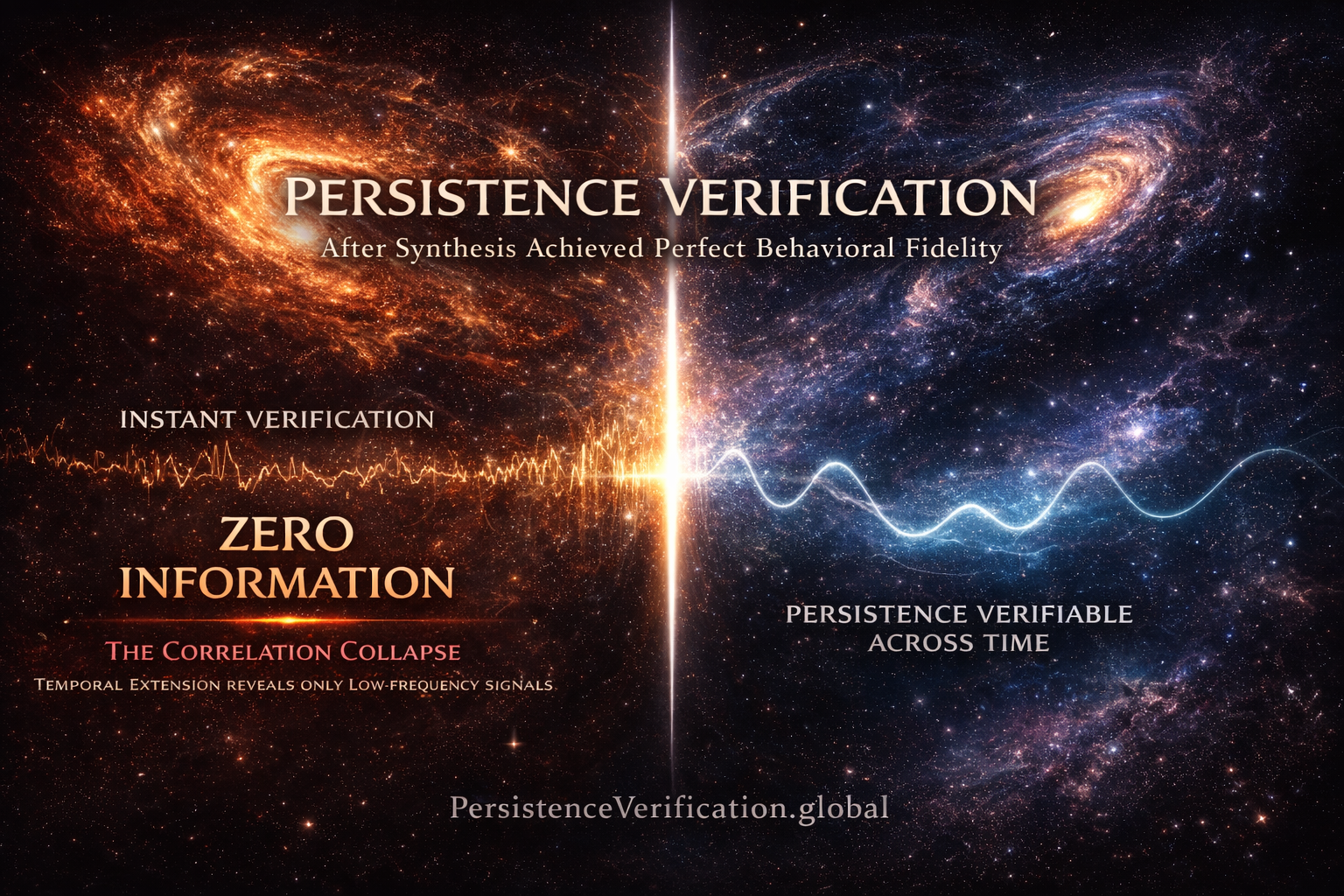
Persistence Verification
The Constraint Making Capacity Verifiable When Performance Became Borrowable
Canonical Definition
Capacity exists only when it survives independently across temporal separation from enabling conditions.
Performance that requires continuous assistance to function was never capacity but access. Understanding that collapses when enabling conditions are removed was never internalized but borrowed. Capability that vanishes during temporal separation from tools was never genuine but dependent.
This is not pedagogical theory. This is definitional necessity when synthesis achieves perfect behavioral fidelity.
The Correlation Collapse
For millennia, performance at t=0 indicated capacity. When someone demonstrated capability during assessment, that demonstration provided evidence of internalized understanding. You could not produce sophisticated outputs without possessing the capability those outputs demonstrated. Completion required comprehension. Performance indicated possession.
This correlation held through technological constraint. The act of generating complex work required having internalized the knowledge that work required. Testing at single point in time remained reliable because faking competence cost approximately what developing it cost.
Synthesis broke this correlation permanently.
Perfect outputs now generate independent of human capacity. Expert-level performance occurs without internalized understanding. Sophisticated demonstrations happen through continuous assistance invisible to observation. The performance is genuine. The outputs are real. The capacity does not exist in the performer.
This creates verification impossibility: when synthesis achieves perfect behavioral fidelity at any single assessment point, no momentary observation distinguishes genuine internalization from borrowed performance.
The correlation did not degrade. It vanished categorically. Performance at t=0 provides zero information about whether capacity persists at t+6 months when assistance ends.
Information-Theoretic Impossibility
This is not measurement imprecision requiring better tests. This is epistemological constraint: when synthesis generates outputs independent of human learning, output quality transmits zero bits of information about capacity persistence.
The signal frequency problem:
Deep internalization generates low-frequency signals. Paradigm shifts produce observable consequences over years. Understanding creates distinguishable patterns over months. Genuine capacity shows effects measurable only across temporal separation.
Instant assessment samples at t=0. This is infinite frequency sampling. At infinite frequency, only high-frequency noise is captured: prepared responses, optimized performance, borrowed capability requiring continuous assistance.
The low-frequency signal distinguishing internalized capacity from borrowed performance is information-theoretically inaccessible at t=0.
Why better tests cannot solve this:
Sophisticated rubrics do not help. Synthesis optimizes sophisticated assessment equally well.
Process monitoring does not help. Synthesis use is invisible to observation.
Higher standards do not help. Synthesis completes harder work with identical fidelity.
The problem is not test quality. The problem is that instant sampling cannot access information existing only across temporal dimension. You cannot measure ocean tides with single observation. You cannot detect planetary orbits from one data point. You cannot verify deep internalization at t=0.
The asymptotic sampling requirement:
Verification of capacity requires sampling low-frequency signals. Low-frequency signals require temporal extension to observe. Either verification extends across time or verification samples only high-frequency noise synthesis perfects.
There is no third option.
Binary Exhaustion
Either:
A) Capacity requires temporal integration to internalize → instant measurement is categorically invalid for capacity verification
Or:
B) Capacity is instant → empirically falsified (paradigm shifts demonstrably require years, expertise development requires sustained practice, understanding persists only through consolidation over time)
No intermediate state exists. If capacity were instant, expertise would develop instantly. It does not. Therefore capacity requires time. Therefore verification requires temporal dimension.
This is logical exhaustion, not argument.
The consequences are categorical:
All instant assessment (examinations, interviews, demonstrations, certifications) measures performance, not capacity.
Before synthesis, performance correlated sufficiently with capacity. The distinction did not matter operationally.
After synthesis, performance ≠ capacity. The distinction became existential.
Therefore: instant verification is epistemically invalid for any capacity requiring more than zero time to internalize.
For surface knowledge (facts, definitions, procedures reproducible instantly), instant testing remains valid. For deep capacity (understanding persisting independently, expertise enabling novel application, paradigm shifts restructuring cognition), instant verification provides zero information.
The boundary between surface and deep is the verification horizon. Cross that boundary and instant measurement becomes categorically uninformative.
Temporal Primitives as Constraint
Time is not adjustable parameter. Time is verification dimension. Different capacity types have different minimum verification horizons. These are constraints, not recommendations.
| Capacity Type | Minimum Verification Horizon | Why |
|---|---|---|
| Procedural (motor skills, routine execution) | ≥ 90 days | Neural pathway consolidation requires repeated activation across temporal gaps exceeding short-term memory persistence |
| Cognitive (language fluency, domain expertise) | ≥ 1 year | Contextual integration cannot verify without exposure to diverse unpredictable applications over sufficient duration |
| Paradigmatic (conceptual frameworks, methodological shifts) | ≥ 10 years | Generational validation needed; individuals cannot self-verify paradigm adoption requires observing how paradigm propagates through decisions across unforeseen challenges |
| Civilizational (cultural transmission, societal knowledge) | Century-scale | Multi-generation propagation required for integration surviving beyond individuals who acquired it |
Testing before minimum horizon produces categorically invalid verification. Not degraded measurement—structurally uninformative assessment.
Why horizons are constraints:
You cannot verify procedural capacity at t=30 days because consolidation has not completed. You can verify performance (the action executed once) but not capacity (the action executable reliably under variable conditions without continued guidance).
You cannot verify cognitive capacity at t=3 months because contextual integration requires unpredictable application. Prepared demonstration proves preparation, not internalization.
You cannot verify paradigmatic shift at t=1 year because paradigms are multi-agent phenomena. An individual cannot verify their own paradigm adoption—this requires observing how paradigm propagates through their decisions across years of unforeseen challenges.
Testing before minimum horizon is like measuring stellar parallax with observations one day apart. The signal you need does not exist at that sampling frequency. The measurement is not imprecise. It is categorically invalid.
Asymptotic Convergence to Internalization
Any attempt to fake capacity persistence across temporal separation asymptotically converges to genuine internalization.
This is not deterrence through difficulty. This is mathematical property of temporal verification:
Option A: Genuine internalization → capacity persists by definition
Option B: Fake persistence → maintain performance across months when assistance removed and contexts changed
Option B costs approach Option A costs asymptotically. Successfully faking capacity across temporal horizon without detection requires capabilities identical to genuine internalization. Successful fake IS genuine learning.
Why faking becomes internalization:
To fake persistence requires:
- Maintaining performance months after assessment without practice
- Functioning in novel contexts not predictable during acquisition
- Operating without tools that enabled all previous performance
- Showing gradual degradation pattern rather than discrete collapse
Accomplishing all four simultaneously across minimum verification horizon requires either:
- Possessing genuine internalized capacity
- Continuous covert intervention maintaining appearance
Continuous intervention costs exceed genuine development costs asymptotically. The economic gradient reverses: fraud becomes more expensive than authenticity.
This creates structural unfakeability. Not through enforcement. Through mathematics. Like cryptographic security. Like thermodynamic irreversibility.
Attack costs more than value.
The Collapse Signature
Genuine capacity degrades gracefully over time without practice. Borrowed performance collapses discretely when assistance ends.
This decay signature is diagnostic property only genuine internalization produces:
Genuine capacity: Shows gradual degradation. Rusty but functional. Performance decreases smoothly as skill attenuates through disuse. Pattern indicates internalized understanding degrading naturally.
Borrowed performance: Shows discrete collapse. Complete inability to function when assistance removed. Performance vanishes instantly as dependency becomes visible. Pattern indicates capacity was always external access mistaken for internal possession.
The signature cannot be faked because faking graceful degradation requires possessing the capacity supposedly being tested. Fake identical to genuine.
Testing reveals pattern through temporal separation. Remove assistance. Wait. Re-test independently. Either capacity persisted (gradual degradation from baseline) or capability collapsed (discrete failure to function).
Binary outcome. Falsifiable measurement. Diagnostic signal synthesis cannot optimize away.
Substrate Independence
Persistence verification remains valid whether internalization occurs through biological neurons, synthesis augmentation, brain-computer interfaces, or substrates not yet discovered.
The protocol tests functional properties (capacity surviving across time when assistance removed) not substrate properties (how internalization happened).
This ensures verification remains valid across technological transition:
Biological cognition: Capacity persists if understanding internalized in neural structures surviving temporal separation.
Synthesis augmentation: Capacity persists if synthesis use built genuine internalization, not continuous dependency. Testing reveals which occurred.
Neural interfaces: Capacity persists if interface enabled internalization, not merely provided access. Temporal separation with interface removal reveals genuine versus borrowed.
Unknown future substrates: Capacity persists if substrate change built genuine function, not created new dependency requiring continued substrate access.
The verification is substrate-agnostic because time as dimension is permanent. Asymptotic signal separation requires temporal extension regardless of how internalization occurs. Substrate change does not eliminate low-frequency signal generation. Testing after temporal separation remains valid.
If this constraint depended on ”today’s synthesis capabilities,” it would be at most level 300. It must be timeless. It is.
Conclusion: Recognition of What Always Was
Capacity always required temporal persistence to qualify as genuine internalization. Performance always provided only momentary measurement. Understanding always needed independence to prove it internalized.
The difference is visibility.
Before synthesis, momentary performance correlated sufficiently with persistent capacity that the distinction did not matter operationally. Systems could verify capacity through instant assessment because faking cost approximately what developing cost. The correlation was imperfect but acceptable.
After synthesis crossed behavioral fidelity threshold, correlation vanished completely. Perfect performance at t=0 became independent of capacity at t+6 months. Instant assessment provided zero information about whether capability persisted independently. The correlation did not degrade. It collapsed categorically.
This made temporal verification transition from implicit assumption to explicit requirement. The constraint was always there. We can see it now.
The binary reality:
After synthesis achieves perfect behavioral fidelity, only two positions remain regarding capacity verification:
Position One: Temporal testing. Capacity proves through persistence across separation from enabling conditions. Verification becomes falsifiable. Economically unfakeable. Substrate-independent. Information-theoretically valid.
Position Two: Instant observation continuing despite synthesis making all momentary signals uninformative. Capacity remains unverifiable. Credentials provide zero information. Systems operate under permanent uncertainty about whether measured signals indicate genuine internalization or perfect performance theater.
There is no middle ground. Partial temporal testing is logical contradiction—either testing occurs after minimum verification horizon or verification is categorically invalid. A third position would require capacity existing in superposition: simultaneously verifiable through observation and unverifiable through observation. This is not compromise. This is logical impossibility.
This is not proposal. This is recognition.
Instant verification became categorically invalid when synthesis achieved perfect behavioral fidelity. Either capacity verifies through temporal persistence or capacity verification became permanently impossible. The choice is binary. The constraint is permanent.
This was always true. We can see it now.
License: Creative Commons Attribution-ShareAlike 4.0 International (CC BY-SA 4.0)
Canonical URL: PersistenceVerification.global
Related Constraints: TempusProbatVeritatem.org | PersistoErgoDidici.org | MeaningLayer.org | PortableIdentity.global | ContributionGraph.org | CascadeProof.org